Laravel Best Practice
Ada repository github yang bagus untuk kita para developer laravel. Di sini menjelaskan best practice laravel yang sering digunakan di real dunia industri.
- Read Laravel Best Practice in Github
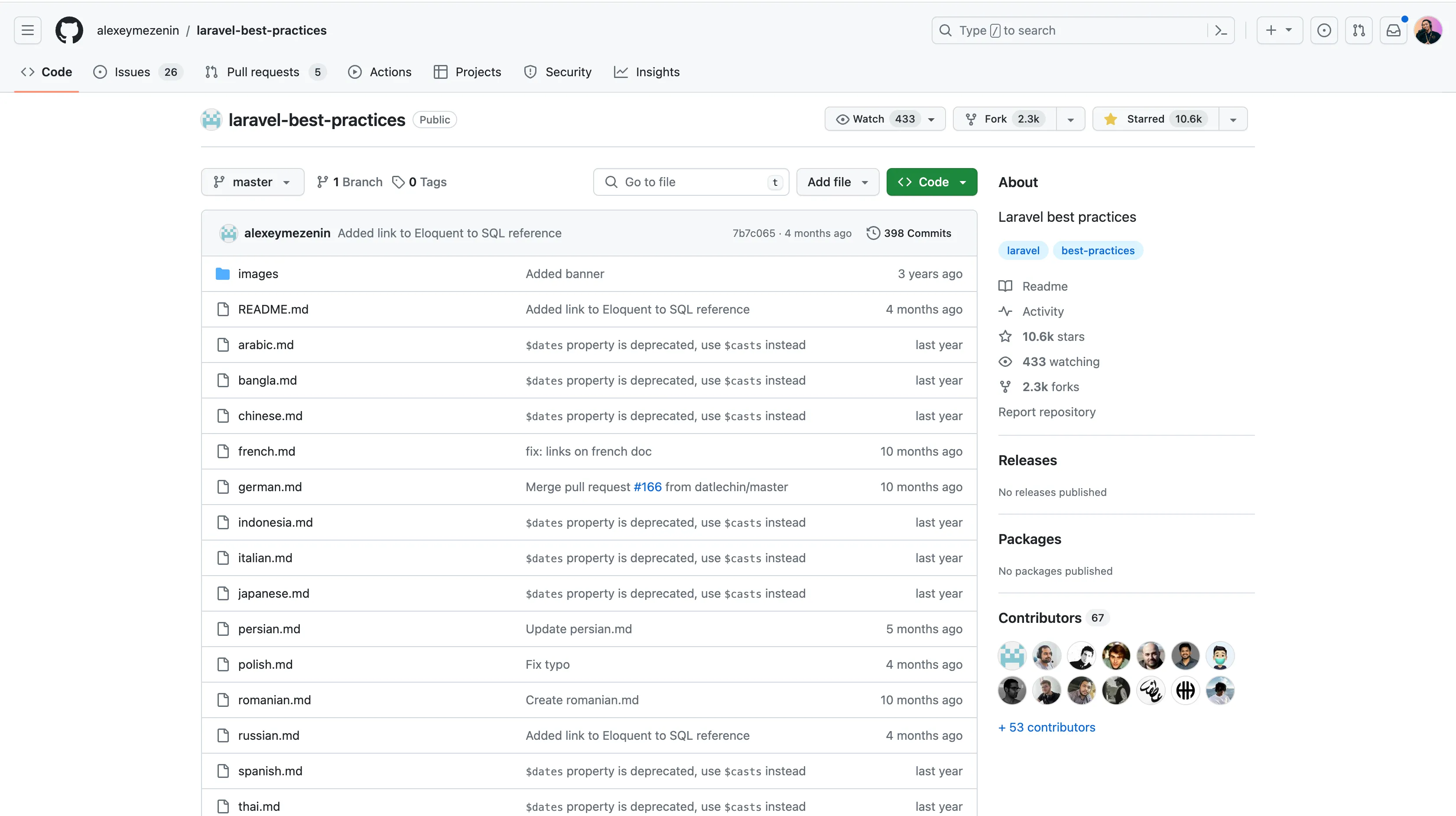
You might also want to check out the real-world Laravel example application and Eloquent SQL reference
Single responsibility principle
Section titled “Single responsibility principle”A class should have only one responsibility.
Bad:
public function update(Request $request): string{    $validated = $request->validate([        'title' => 'required|max:255',        'events' => 'required|array:date,type'    ]);
    foreach ($request->events as $event) {        $date = $this->carbon->parse($event['date'])->toString();
        $this->logger->log('Update event ' . $date . ' :: ' . $);    }
    $this->event->updateGeneralEvent($request->validated());
    return back();}
Good:
public function update(UpdateRequest $request): string{    $this->logService->logEvents($request->events);
    $this->event->updateGeneralEvent($request->validated());
    return back();}
Methods should do just one thing
Section titled “Methods should do just one thing”A function should do just one thing and do it well.
Bad:
public function getFullNameAttribute(): string{ if (auth()->user() && auth()->user()->hasRole('client') && auth()->user()->isVerified()) { return 'Mr. ' . $this->first_name . ' ' . $this->middle_name . ' ' . $this->last_name; } else { return $this->first_name[0] . '. ' . $this->last_name; }}Good:
public function getFullNameAttribute(): string{    return $this->isVerifiedClient() ? $this->getFullNameLong() : $this->getFullNameShort();}
public function isVerifiedClient(): bool{    return auth()->user() && auth()->user()->hasRole('client') && auth()->user()->isVerified();}
public function getFullNameLong(): string{    return 'Mr. ' . $this->first_name . ' ' . $this->middle_name . ' ' . $this->last_name;}
public function getFullNameShort(): string{    return $this->first_name[0] . '. ' . $this->last_name;}
Fat models, skinny controllers
Section titled “Fat models, skinny controllers”Put all DB related logic into Eloquent models.
Bad:
public function index(){    $clients = Client::verified()        ->with(['orders' => function ($q) {            $q->where('created_at', '>', Carbon::today()->subWeek());        }])        ->get();
    return view('index', ['clients' => $clients]);}
Good:
public function index(){    return view('index', ['clients' => $this->client->getWithNewOrders()]);}
class Client extends Model{    public function getWithNewOrders(): Collection    {        return $this->verified()            ->with(['orders' => function ($q) {                $q->where('created_at', '>', Carbon::today()->subWeek());            }])            ->get();    }}
Validation
Section titled “Validation”Move validation from controllers to Request classes.
Bad:
public function store(Request $request){    $request->validate([        'title' => 'required|unique:posts|max:255',        'body' => 'required',        'publish_at' => 'nullable|date',    ]);
    ...}
Good:
public function store(PostRequest $request){    ...}
class PostRequest extends Request{    public function rules(): array    {        return [            'title' => 'required|unique:posts|max:255',            'body' => 'required',            'publish_at' => 'nullable|date',        ];    }}
Business logic should be in service class
Section titled “Business logic should be in service class”A controller must have only one responsibility, so move business logic from controllers to service classes.
Bad:
public function store(Request $request){    if ($request->hasFile('image')) {        $request->file('image')->move(public_path('images') . 'temp');    }
    ...}
Good:
public function store(Request $request){    $this->articleService->handleUploadedImage($request->file('image'));
    ...}
class ArticleService{    public function handleUploadedImage($image): void    {        if (!is_null($image)) {            $image->move(public_path('images') . 'temp');        }    }}
Don’t repeat yourself (DRY)
Section titled “Don’t repeat yourself (DRY)”Reuse code when you can. SRP is helping you to avoid duplication. Also, reuse Blade templates, use Eloquent scopes etc.
Bad:
public function getActive(){    return $this->where('verified', 1)->whereNotNull('deleted_at')->get();}
public function getArticles(){    return $this->whereHas('user', function ($q) {            $q->where('verified', 1)->whereNotNull('deleted_at');        })->get();}
Good:
public function scopeActive($q){    return $q->where('verified', true)->whereNotNull('deleted_at');}
public function getActive(): Collection{    return $this->active()->get();}
public function getArticles(): Collection{    return $this->whereHas('user', function ($q) {            $q->active();        })->get();}
Prefer to use Eloquent over using Query Builder and raw SQL queries. Prefer collections over arrays
Section titled “Prefer to use Eloquent over using Query Builder and raw SQL queries. Prefer collections over arrays”Eloquent allows you to write readable and maintainable code. Also, Eloquent has great built-in tools like soft deletes, events, scopes etc. You may want to check out Eloquent to SQL reference
Bad:
SELECT *FROM `articles`WHERE EXISTS (SELECT * FROM `users` WHERE `articles`.`user_id` = `users`.`id` AND EXISTS (SELECT * FROM `profiles` WHERE `profiles`.`user_id` = `users`.`id`) AND `users`.`deleted_at` IS NULL)AND `verified` = '1'AND `active` = '1'ORDER BY `created_at` DESCGood:
Article::has('user.profile')->verified()->latest()->get();Mass assignment
Section titled “Mass assignment”Bad:
$article = new Article;$article->title = $request->title;$article->content = $request->content;$article->verified = $request->verified;
// Add category to article$article->category_id = $category->id;$article->save();
Good:
$category->article()->create($request->validated());Do not execute queries in Blade templates and use eager loading (N + 1 problem)
Section titled “Do not execute queries in Blade templates and use eager loading (N + 1 problem)”Bad (for 100 users, 101 DB queries will be executed):
@foreach (User::all() as $user) {{ $user->profile->name }}@endforeachGood (for 100 users, 2 DB queries will be executed):
$users = User::with('profile')->get();
@foreach ($users as $user)    {{ $user->profile->name }}@endforeach
Chunk data for data-heavy tasks
Section titled “Chunk data for data-heavy tasks”Bad:
$users = $this->get();
foreach ($users as $user) {    ...}
Good:
$this->chunk(500, function ($users) { foreach ($users as $user) { ... }});Prefer descriptive method and variable names over comments
Section titled “Prefer descriptive method and variable names over comments”Bad:
// Determine if there are any joinsif (count((array) $builder->getQuery()->joins) > 0)Good:
if ($this->hasJoins())Do not put JS and CSS in Blade templates and do not put any HTML in PHP classes
Section titled “Do not put JS and CSS in Blade templates and do not put any HTML in PHP classes”Bad:
let article = `{{ json_encode($article) }}`;Better:
<input id="article" type="hidden" value='@json($article)'>
Or
<button class="js-fav-article" data-article='@json($article)'>{{ $article->name }}<button>
In a Javascript file:
let article = $("#article").val();The best way is to use specialized PHP to JS package to transfer the data.
Use config and language files, constants instead of text in the code
Section titled “Use config and language files, constants instead of text in the code”Bad:
public function isNormal(): bool{    return $article->type === 'normal';}
return back()->with('message', 'Your article has been added!');
Good:
public function isNormal(){    return $article->type === Article::TYPE_NORMAL;}
return back()->with('message', __('app.article_added'));
Use standard Laravel tools accepted by community
Section titled “Use standard Laravel tools accepted by community”Prefer to use built-in Laravel functionality and community packages instead of using 3rd party packages and tools. Any developer who will work with your app in the future will need to learn new tools. Also, chances to get help from the Laravel community are significantly lower when you’re using a 3rd party package or tool. Do not make your client pay for that.
| Task | Standard tools | 3rd party tools |
|---|---|---|
| Authorization | Policies | Entrust, Sentinel and other packages |
| Compiling assets | Laravel Mix, Vite | Grunt, Gulp, 3rd party packages |
| Development Environment | Laravel Sail, Homestead | Docker |
| Deployment | Laravel Forge | Deployer and other solutions |
| Unit testing | PHPUnit, Mockery | Phpspec, Pest |
| Browser testing | Laravel Dusk | Codeception |
| DB | Eloquent | SQL, Doctrine |
| Templates | Blade | Twig |
| Working with data | Laravel collections | Arrays |
| Form validation | Request classes | 3rd party packages, validation in controller |
| Authentication | Built-in | 3rd party packages, your own solution |
| API authentication | Laravel Passport, Laravel Sanctum | 3rd party JWT and OAuth packages |
| Creating API | Built-in | Dingo API and similar packages |
| Working with DB structure | Migrations | Working with DB structure directly |
| Localization | Built-in | 3rd party packages |
| Realtime user interfaces | Laravel Echo, Pusher | 3rd party packages and working with WebSockets directly |
| Generating testing data | Seeder classes, Model Factories, Faker | Creating testing data manually |
| Task scheduling | Laravel Task Scheduler | Scripts and 3rd party packages |
| DB | MySQL, PostgreSQL, SQLite, SQL Server | MongoDB |
Follow Laravel naming conventions
Section titled “Follow Laravel naming conventions”Follow PSR standards.
Also, follow naming conventions accepted by Laravel community:
| What | How | Good | Bad |
|---|---|---|---|
| Controller | singular | ArticleController | |
| Route | plural | articles/1 | |
| Route name | snake_case with dot notation | users.show_active | |
| Model | singular | User | |
| hasOne or belongsTo relationship | singular | articleComment | |
| All other relationships | plural | articleComments | |
| Table | plural | article_comments | |
| Pivot table | singular model names in alphabetical order | article_user | |
| Table column | snake_case without model name | meta_title | |
| Model property | snake_case | $model->created_at | |
| Foreign key | singular model name with _id suffix | article_id | |
| Primary key | - | id | |
| Migration | - | 2017_01_01_000000_create_articles_table | |
| Method | camelCase | getAll | |
| Method in resource controller | table | store | |
| Method in test class | camelCase | testGuestCannotSeeArticle | |
| Variable | camelCase | $articlesWithAuthor | |
| Collection | descriptive, plural | $activeUsers = User::active()->get() | |
| Object | descriptive, singular | $activeUser = User::active()->first() | |
| Config and language files index | snake_case | articles_enabled | |
| View | kebab-case | show-filtered.blade.php | |
| Config | snake_case | google_calendar.php | |
| Contract (interface) | adjective or noun | AuthenticationInterface | |
| Trait | adjective | Notifiable | |
| Trait (PSR) | adjective | NotifiableTrait | |
| Enum | singular | UserType | |
| FormRequest | singular | UpdateUserRequest | |
| Seeder | singular | UserSeeder |
Convention over configuration
Section titled “Convention over configuration”As long as you follow certain conventions, you do not need to add additional configuration.
Bad:
// Table name 'Customer'// Primary key 'customer_id'class Customer extends Model{    const CREATED_AT = 'created_at';    const UPDATED_AT = 'updated_at';
    protected $table = 'Customer';    protected $primaryKey = 'customer_id';
    public function roles(): BelongsToMany    {        return $this->belongsToMany(Role::class, 'role_customer', 'customer_id', 'role_id');    }}
Good:
// Table name 'customers'// Primary key 'id'class Customer extends Model{ public function roles(): BelongsToMany { return $this->belongsToMany(Role::class); }}Use shorter and more readable syntax where possible
Section titled “Use shorter and more readable syntax where possible”Bad:
$request->session()->get('cart');$request->input('name');Good:
session('cart');$request->name;More examples:
| Common syntax | Shorter and more readable syntax |
|---|---|
Session::get('cart') | session('cart') |
$request->session()->get('cart') | session('cart') |
Session::put('cart', $data) | session(['cart' => $data]) |
$request->input('name'), Request::get('name') | $request->name, request('name') |
return Redirect::back() | return back() |
is_null($object->relation) ? null : $object->relation->id | optional($object->relation)->id (in PHP 8: $object->relation?->id) |
return view('index')->with('title', $title)->with('client', $client) | return view('index', compact('title', 'client')) |
$request->has('value') ? $request->value : 'default'; | $request->get('value', 'default') |
Carbon::now(), Carbon::today() | now(), today() |
App::make('Class') | app('Class') |
->where('column', '=', 1) | ->where('column', 1) |
->orderBy('created_at', 'desc') | ->latest() |
->orderBy('age', 'desc') | ->latest('age') |
->orderBy('created_at', 'asc') | ->oldest() |
->select('id', 'name')->get() | ->get(['id', 'name']) |
->first()->name | ->value('name') |
Use IoC / Service container instead of new Class
Section titled “Use IoC / Service container instead of new Class”new Class syntax creates tight coupling between classes and complicates testing. Use IoC container or facades instead.
Bad:
$user = new User;$user->create($request->validated());Good:
public function __construct(User $user){    $this->user = $user;}
...
$this->user->create($request->validated());
Do not get data from the .env file directly
Section titled “Do not get data from the .env file directly”Pass the data to config files instead and then use the config() helper function to use the data in an application.
Bad:
$apiKey = env('API_KEY');Good:
'key' => env('API_KEY'),
// Use the data$apiKey = config('api.key');
Store dates in the standard format. Use accessors and mutators to modify date format
Section titled “Store dates in the standard format. Use accessors and mutators to modify date format”A date as a string is less reliable than an object instance, e.g. a Carbon-instance. It’s recommended to pass Carbon objects between classes instead of date strings. Rendering should be done in the display layer (templates):
Bad:
{{ Carbon::createFromFormat('Y-d-m H-i', $object->ordered_at)->toDateString() }}{{ Carbon::createFromFormat('Y-d-m H-i', $object->ordered_at)->format('m-d') }}Good:
// Modelprotected $casts = [    'ordered_at' => 'datetime',];
// Blade view{{ $object->ordered_at->toDateString() }}{{ $object->ordered_at->format('m-d') }}
Do not use DocBlocks
Section titled “Do not use DocBlocks”DocBlocks reduce readability. Use a descriptive method name and modern PHP features like return type hints instead.
Bad:
/** * The function checks if given string is a valid ASCII string * * @param string $string String we get from frontend which might contain *                       illegal characters. Returns True is the string *                       is valid. * * @return bool * @author  John Smith * * @license GPL */
public function checkString($string){}
Good:
public function isValidAsciiString(string $string): bool{}Other good practices
Section titled “Other good practices”Avoid using patterns and tools that are alien to Laravel and similar frameworks (i.e. RoR, Django). If you like Symfony (or Spring) approach for building apps, it’s a good idea to use these frameworks instead.
Never put any logic in routes files.
Minimize usage of vanilla PHP in Blade templates.
Use in-memory DB for testing.
Do not override standard framework features to avoid problems related to updating the framework version and many other issues.
Use modern PHP syntax where possible, but don’t forget about readability.
Avoid using View Composers and similar tools unless you really know what you’re doing. In most cases, there is a better way to solve the problem.